What Is Motor Learning Theory, the Foundation?
日本語で読む →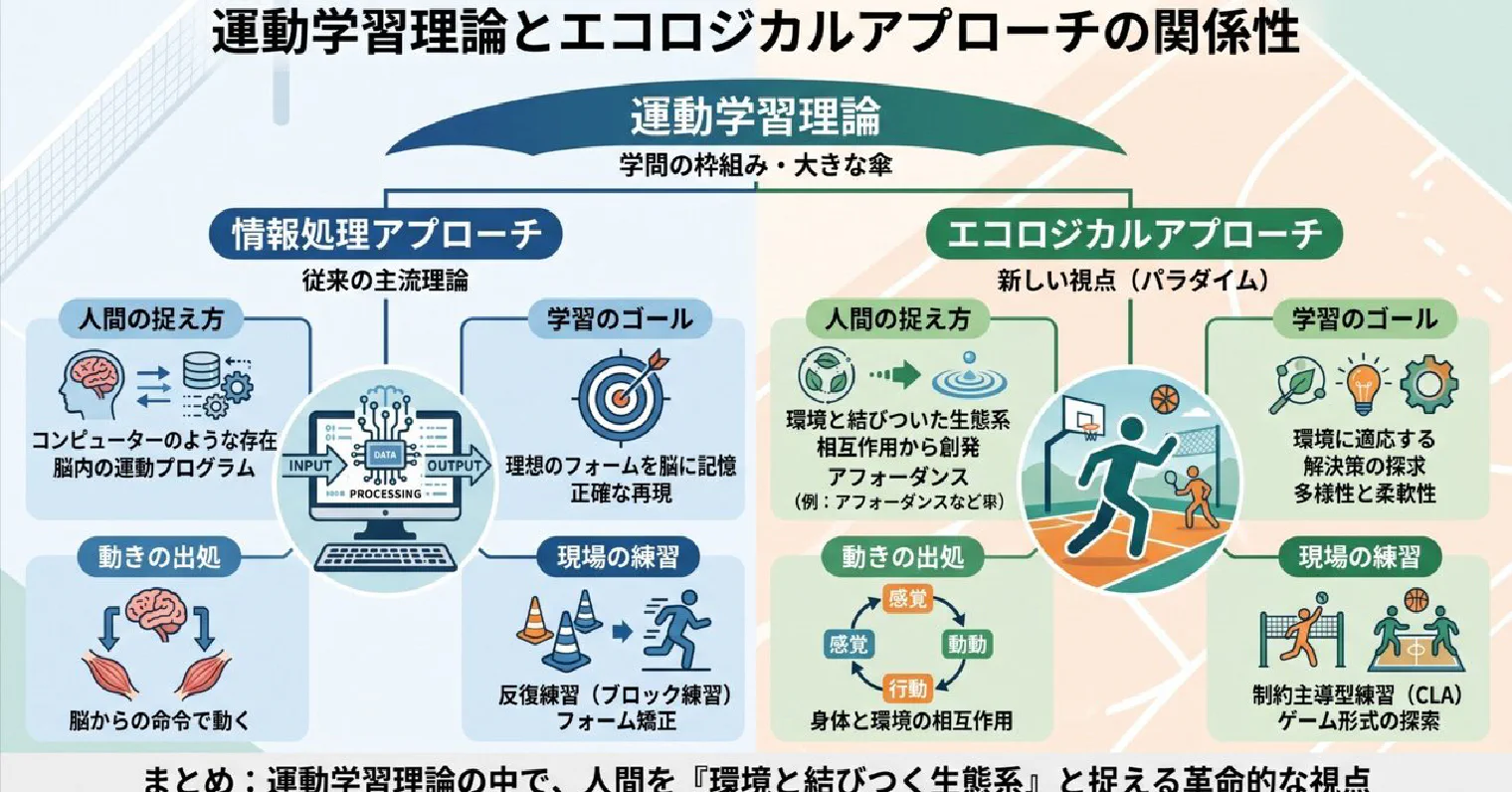
What is the ecological approach? There are many ways to answer that question, but in a word, it can be described as one of the motor learning theories that are attracting a great deal of attention and research in sport science today.
So what is “motor learning theory,” the premise here?
What is motor learning theory?
First, the “motor learning” part refers to
“the process of acquiring a particular movement or skill through experience, until you can perform it consistently.”
In volleyball, the process of learning to hit a spike is one example. But this is by no means limited to sport. It is an extremely universal mechanism that applies to “the whole process by which humans (or animals) acquire new movements” in order to live.
For example, our daily lives are full of motor learning.
- Everyday movements: learning to use chopsticks well. Changing your stride without thinking so you don’t fall on a bumpy mountain path or a snowy road. Riding a bicycle for the first time.
- Art and music: learning to play an instrument such as the piano or guitar.
- Work and skills: learning to drive a car in a straight line. Learning to type without looking at the keyboard (touch typing). (I’ll soon share the practice method I used to learn touch typing in a short time!)
Once acquired (learned), I don’t think these skills are easily lost. It is not a temporary change, such as your muscles simply getting stronger. The brain, the nervous system, and the whole body adapt, and “can’t do it” changes permanently into “can do it (and without even thinking).” That process itself is motor learning.
In none of these cases are you giving yourself orders in your head, like “move your right hand so many centimetres…” They are processes in which the body and the environment (tools and space) interact, and the optimal movement is naturally drawn out and becomes established.
Then we add the word “theory.” In other words, motor learning theory can be described as
a field of study (a way of thinking) that tries to explain the mechanism by which people acquire skills (movements).
From here, let’s take a brief look at a motor learning theory that is not the ecological approach.
The information-processing approach (schema theory and others)
The ecological approach is often contrasted with the traditional information-processing approach (schema theory and others).
This traditional theory treats human beings almost like computers.
How it works
It assumes that the human brain stores “programs for ideal movements,” like software on a PC.
- Information comes in through the eyes (input).
- The brain judges the situation and selects the best program from memory (processing).
- It sends commands to the muscles (output).
It explains that movement happens through this sequence.
The learning process
Accordingly, it holds that motor learning means “using repetitive practice to make the brain memorize its programs more accurately and more firmly.” The familiar coaching in sport, “get the correct technique” and “repeat it until your body remembers,” is based on exactly this theory.
Motor learning theory is the foundation of coaching
What kind of being do we take people to be? A computer that accumulates programs in its brain, or a complex being that adapts flexibly to its surroundings? Precisely because this underlying “theory” differs, actual coaching and practice design change from the ground up.
Why we need motor learning theory now
In sport today, I feel that even where there is plenty of specialist knowledge of the game based on personal experience, there is a lack of understanding of, and opportunities to learn, the most fundamental thing of all: motor learning theory, the question of “how do people learn movement in the first place?”
Knowing the mechanism by which people learn movement should be the most important key in coaching. And we coaches will probably need to change our fundamental attitude toward coaching, and rethink our very role once more.