Design the Attention: What Coaches Need to Know About External Focus
日本語で読む →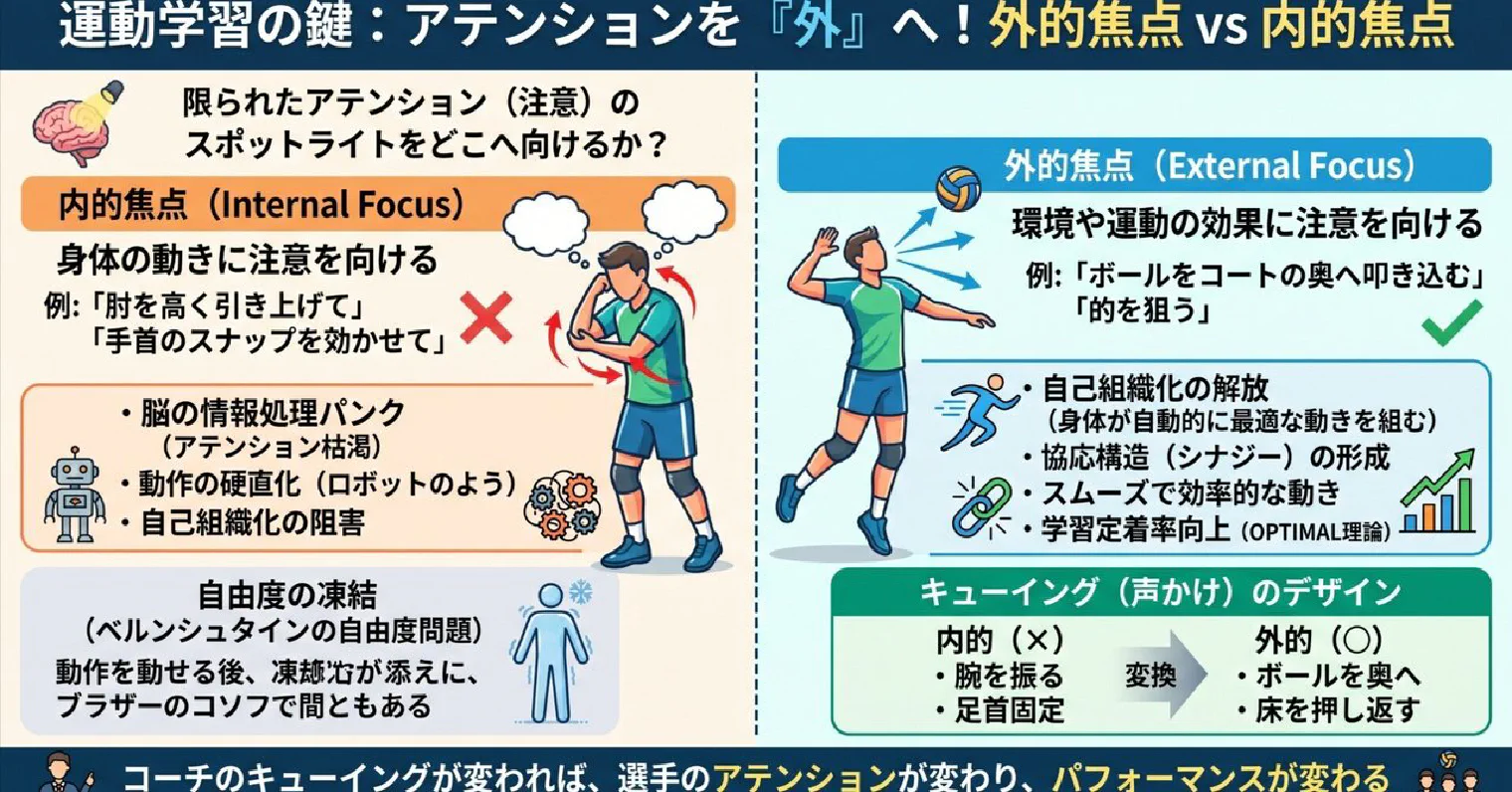
In the previous post, I explained that a player’s attention is a limited cognitive resource, and what goes wrong when it runs dry.
As a follow-up, this post digs into the practical side: where, specifically, should we point that limited spotlight of attention?
You often hear advice in the gym that draws players’ awareness to their body movements, such as “snap your wrist more” or “bend your knees properly.” What if comments like these were quietly holding back players’ development and their performance, without anyone noticing?
To give you the conclusion first: what matters in motor learning is not an “internal focus” on your own body, but an “external focus” on the environment and the effects outside yourself.
So what kinds of cues and environments should we coaches design to get the most out of our players? Here is a summary of how to put this into practice.
Two directions of attention: internal focus and external focus
Definitions and concrete differences
Broadly speaking, attention can point in two directions.
Internal focus:
Paying attention to the movements of your own body parts. (For example: the arm swing, the angle of your feet.)
External focus:
Paying attention to the environment outside the body, or to the effect the movement produces. (For example: the ball’s flight, a target, the force of pushing against the floor.)
Internal versus external, seen through the spike
Internal focus and external focus may sound a little abstract as words alone. But once you apply them to the volleyball spike, the difference becomes clear.
[Internal-focus cues]
- “Open your chest up in the air.”
- “Pull your elbow up high.”
- “Snap your wrist.”
👉 These direct attention to the movements of your own body parts, so they are internal focus.
[External-focus cues]
- “Hit the centre of the ball cleanly.”
- “Aim for the gap in the opponent’s block.”
- “Hit it hard at the highest point.”
👉 These direct attention to things outside the body, the ball, a target, or the result of the movement, so they are external focus.
When teaching a beginner a new movement, or in the early stages of correcting technique, it is natural for a player’s attention to turn temporarily toward their own body (internal focus). But if, during actual play, players are thinking only about “body angle” or “elbow height,” they will inevitably be slow to respond to the external environment: the flight of the set, which changes every time, or the movement of the opposing blockers.
To perform movements smoothly and deliver performance that fits the situation, players need to switch the spotlight of their awareness from “their own body” to “the environment outside.”
The trap of well-meant advice: cueing that relies on internal focus
But this is where coaching gets really difficult. When we coach, we tend to give cues based on internal focus without even realizing it: “Get your elbow higher,” “Snap that wrist.”
As coaches, we mean well. We think pointing to a specific body part will be easier to understand. In fact, though, this cueing that relies on internal focus is exactly what later restricts the player’s movement and opens the door to depleting attention, a precious cognitive resource.
Too much emphasis on body parts such as “elbow height” or “wrist angle” causes an information-processing overload in the player’s brain. There is a limit to the cognitive resources the human brain can process at once, so trying to control each part’s movement one by one during play quickly exceeds that capacity.
The most obvious harm caused by this depletion of attention is movement rigidity.
Our bodies are naturally equipped with the ability to self-organize: each part links up with the others on its own, in pursuit of an external goal. But intervening too much to consciously control specific parts disrupts this system, and the result is stiff, robotic movement. When players worry too much about their technique during a match and their movement falls apart, that is precisely the trap created by overusing internal focus.
Is it impossible to control the body part by part? Bernstein’s degrees-of-freedom problem
There is an important concept from sport science for understanding this movement rigidity and disrupted self-organization more deeply: the degrees-of-freedom problem, proposed by the Soviet physiologist Nikolai Bernstein.
The human body has countless joints and muscles (= degrees of freedom). In complex, explosive movements like those in sport, it is impossible for the brain to calculate every one of these degrees of freedom individually and control them consciously.
Yet internal-focus cues make players strongly aware of specific body parts. Not only can the brain’s processing no longer keep up, but the body’s countless degrees of freedom get forcibly restricted and locked rigid (freezing the degrees of freedom). This is what movement rigidity really is.
So what happens when we use external focus, pointing awareness outward?
Unlock self-organization with external focus
What changes in a player’s performance when the spotlight of awareness is pointed at an external goal? The biggest benefit is that the body’s built-in ability to self-organize is released to the full.
When attention is directed at an external goal, the body naturally links its countless joints and muscles and automatically assembles the optimal movement. Sport science calls this the formation of coordinative structures (synergies). Using external-focus cues to reduce the load on the brain and draw out these synergies is the key to smooth, highly adaptable performance.
For example, when a player focuses on an external effect such as “drive the ball deep into the court,” they let go of fine control such as “elbow height.” The body then adjusts its degrees of freedom automatically and assembles, on its own, the movement that achieves the goal most efficiently. Unnecessary tension disappears, the efficiency of force transfer improves dramatically, and players can deliver natural, dynamic performance.
The advantage of external focus is also strongly supported from the perspective of OPTIMAL theory, which is leading the way in motor learning. Many studies have shown that coaching with an external focus not only improves performance in the moment but also greatly improves long-term retention of learning.
Designing your cues
So far, I have explained why external focus matters and how it works. But to practise this in real coaching and draw out players’ performance, we coaches have to change first.
When you coach, do you find yourself unconsciously using words that encourage an internal focus, like “bend your knees more” or “get your arm up higher”?
The first step toward external-focus cueing is to objectively recognize your own everyday “habits” when giving instructions.
Once you notice the tendencies in the words you use without thinking, all that is left is to translate them on purpose.
- “Swing your arm hard (internal)” 👉 “Drive the ball deep into the court (external).”
- “Keep your ankle locked (internal)” 👉 “Push the floor away hard (external).”
The coach intentionally designs and chooses words that turn the player’s awareness from “inside the body” to “the environment and the goal outside.” When a coach’s cues change, the direction of the players’ attention changes, and their movement and performance should naturally change with it.
At tomorrow’s practice, ask yourself whether the words you use with your players are “internal” or “external.” Try recording yourself, and take an honest look back.
What learners (players) need is an external focus.
What we coaches need is to design that external focus.