The Two Pillars That Spark Intrinsic Motivation
日本語で読む →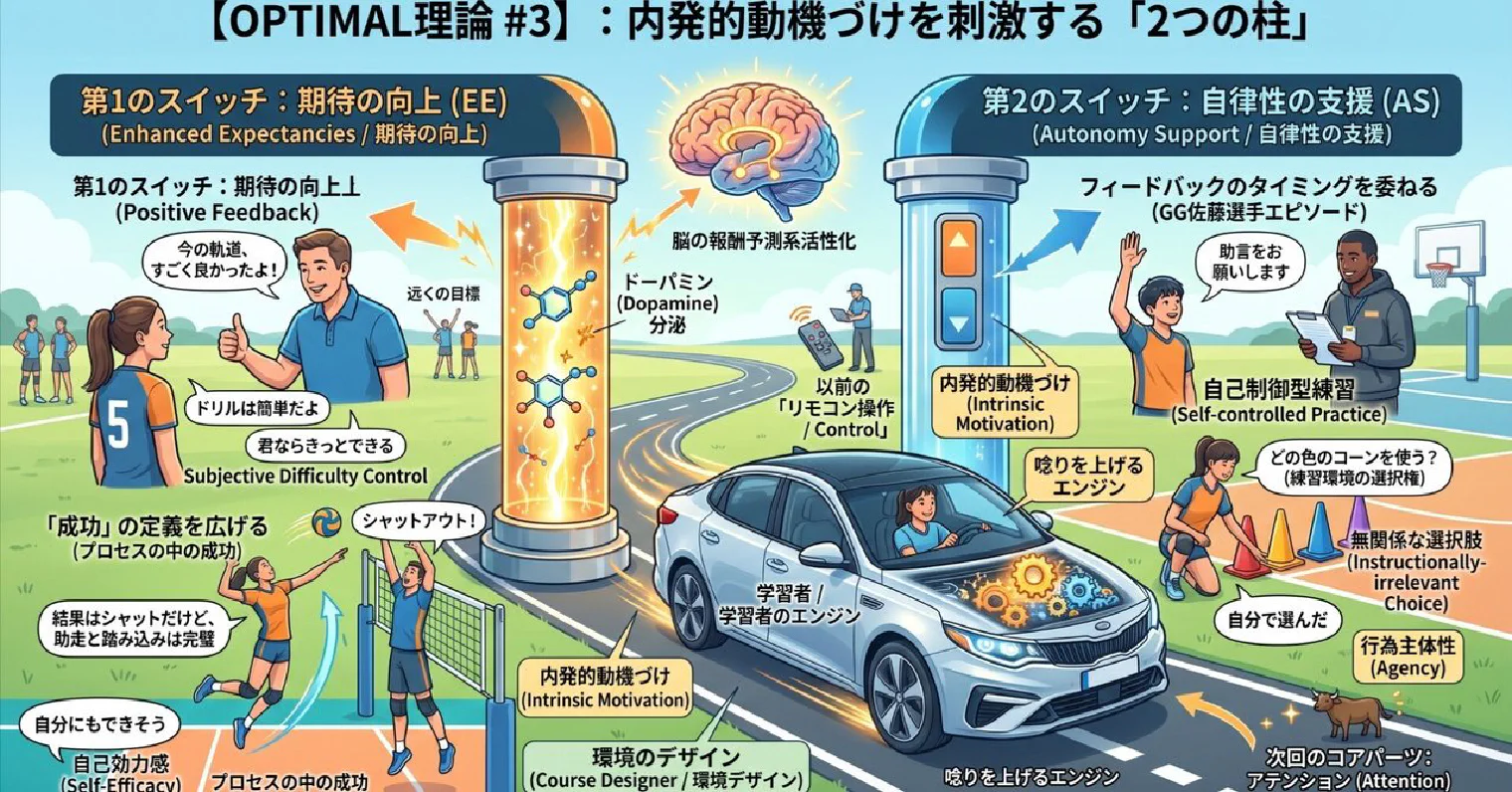
From here, I want to dig into the two pillars that act as concrete switches for physically starting the learner’s engine, motivation (intrinsic motivation): enhanced expectancies and autonomy support.
Switch one: enhanced expectancies
“Enhanced expectancies” means raising the learner’s subjective sense of the probability of success in future performance, the feeling that “I can do this” or “it will work next time.” In other words, raising their self-efficacy.
This is not simply the mindset of “if you try hard, you can do it.” It rests on a neuroscientific mechanism: the moment learners anticipate success, the brain’s reward-prediction system is activated and the neurotransmitter dopamine is released. That dopamine gives a strong boost to the consolidation of motor memory.
Concrete ways to boost expectancies
Positive feedback
The most common method is to give learners positive feedback. Many studies have shown that learning effects last longer when you give knowledge of results on the most accurate attempts, for example “that swing path was really good!”, than when you point out mistakes and correct them.
Shaping perceived difficulty
Even without changing the physical difficulty of a task, simply telling players “most people find this drill easy” or “I’m sure you’ll get it quickly” lowers the psychological hurdle and improves performance. Interestingly, even irrational interventions, such as placebo effects or handing someone a “lucky charm,” raise learners’ expectations of success and, as a result, improve performance.
Personally, a small worry crosses my mind: “Couldn’t a comment like that actually add pressure?” But here I want to trust the current scientific evidence and put it to use.
Widening the definition of “success”
Say a spike gets stuffed by the block. You can still keep a player’s expectations high by picking out the “success” inside the process: “The result was a block, but your approach and the timing of your plant step were perfect.” Especially for beginners, or in the early stages of learning a new skill, this kind of expectancy management has a huge effect on motivation.
Switch two: autonomy support
The second pillar is autonomy support, giving players themselves a sense of control over the learning process.
When everything is managed and dictated by others, people unconsciously lose their sense of agency, and their intrinsic motivation drops. Conversely, even the feeling of “I chose this myself” about something small creates psychological safety and optimizes readiness to move. The typical way to build this into coaching is self-controlled practice.
Self-controlled practice that boosts autonomy
Let players choose when to get feedback
Instead of the coach chiming in after every play, give players the right to decide when to ask for feedback: “Come and ask me when things aren’t going well, or when you want help.” Players then come looking for answers when they feel something went well, or when they really want a hint for a correction, so they absorb the information far better.
Japanese professional baseball player G.G. Sato, who also played in Major League Baseball, has said that when he first went to the United States he grew frustrated because the hitting coach never came to teach him. But one day, struggling with his timing, he went to the coach himself and asked for advice. The coach, as if to say “I’ve been waiting for this,” pulled detailed data out of his briefcase and gave him precise feedback. It is not hard to imagine that this coach understood the theory of intrinsic motivation well and was deliberately leaving the timing to the player.
Choice over the practice environment and schedule
Letting players decide the order of tasks also works: “For serve-receive today, do you want to start with short serves, or with deep ones?” Even more interesting, it has been shown that even small choices with no direct link to the skill (instructionally irrelevant choices), such as “which colour of cone to use,” improve learners’ intrinsic motivation. It may be a bit of a challenge for coaches, but offering several options in daily practice plans and equipment (the colour of the balls, for example) and letting players choose is also very effective. Let’s put the learner first, not what is easiest for us to control.
From “remote control” to “designing a course they can drive themselves”
Enhanced expectancies and autonomy support. What these two switches point to is a fundamental shift in the coach’s role.
The job is not to control players from outside and “drill in” the correct movement, like steering a remote-control car. It is to design an environment in which players themselves believe “I can do this” (expectancy) and feel “I’m the one holding the steering wheel” (autonomy). Our job as coaches is nothing other than preparing the “kindling” that lights their inner engines.
When both switches, expectancy and autonomy, have been pressed and the great engine of motivation roars into life… the car is ready to accelerate.
Yet however powerful the engine, a car will wander if its direction keeps drifting. In the next post, I will finally take apart attention, the powerful steering wheel that guides this now self-driving car toward optimal learning.