The Science of Intrinsic Motivation: Learners Who Drive Themselves
日本語で読む →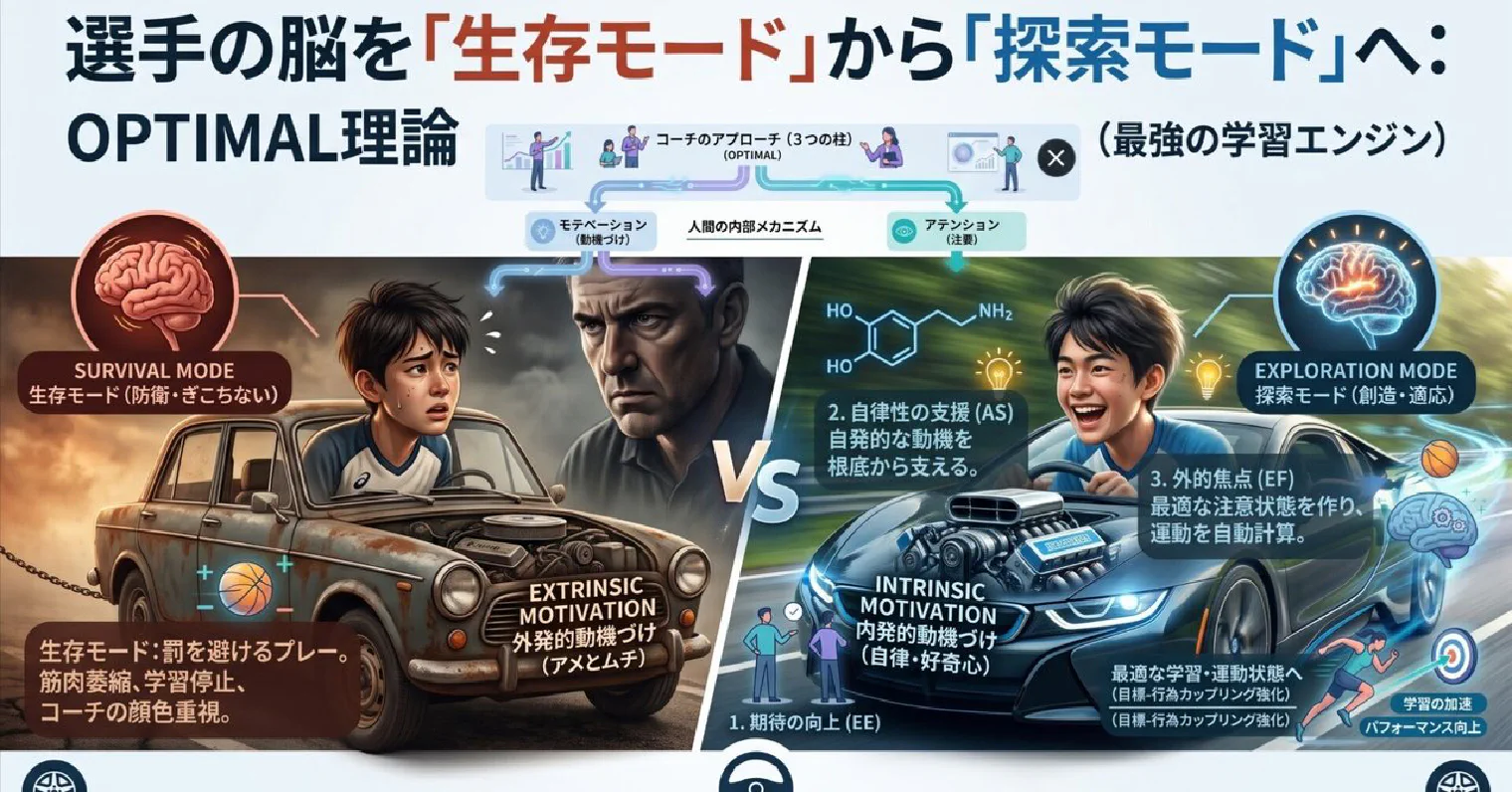
In the previous post I gave a rough overview of OPTIMAL theory. From this post on, I will start taking it apart. Here I focus on motivation (intrinsic motivation), the fundamental engine that drives the learner, our “car,” powerfully forward.
The mechanism of OPTIMAL theory, explained with a car (the learner)
Let’s picture the learner as a car. For this car to set off smoothly and as quickly as possible toward its destination (acquiring a skill), two key parts have to work properly: motivation and attention.
Only when these two work together does the drive shaft, called goal-action coupling, turn smoothly, sending power to the tyres so that the car moves forward on its own. This time, I focus on the first of these key parts: motivation.
Part one: motivation = the engine
Motivation is the fundamental energy (the power source) that moves the car forward. If the engine is stone cold or out of fuel, the car will not move, however fine its body (physical ability) may be.
Motivation here means the first great engine in the car called OPTIMAL theory: intrinsic motivation.
In sport, I think the word “motivation” has long been treated as a matter of mindset or willpower, and at times brushed aside. In this theory, however, intrinsic motivation is positioned scientifically as
“the trigger that directly sets off motor learning (an update of the brain and body).”
What intrinsic motivation really is: dopamine
The biggest highlight of OPTIMAL theory is that it connects psychology with neuroscience (brain science).
When players feel that they are doing something because they choose to, not because they are made to, and that they can do it, the brain releases a neurotransmitter called dopamine. Dopamine does more than lift your mood. It physically promotes the consolidation of motor memory (the building of neural circuits).
In other words, having the engine of intrinsic motivation running is not some vague matter of mindset. It is the biochemical state in which the brain absorbs motor skills most readily.
The limits of extrinsic motivation (the car being towed)
To understand intrinsic motivation properly, let’s first sort out its opposite: extrinsic motivation.
Extrinsic motivation is
a state in which you act to gain an external reward, or to avoid punishment.
This is the familiar “carrot and stick.” To use our analogy, it is a car (the learner) being forcibly pushed from behind, or towed by another car.
Yes, an outside force will move the car forward. But when that force disappears, the car naturally stops. Players may also stop trying whenever the coach is not watching. This does not develop independent learners (cars that can drive themselves) who turn their own engines and keep moving.
Even more serious is the effect on the brain. When players play “so as not to get yelled at” or “to avoid a penalty,” the brain perceives the situation as a threat. Defensive instincts kick in, muscles tense up unnecessarily, and movement becomes stiff. Because the brain switches from learning mode into survival mode, the consolidation of new skills physically stops.
Above all, the players’ attention is stolen. Their focus turns to the coach’s face instead of the task in front of them. The real goal, “how can I land the ball deep in the court?”, gets replaced by “how should I move so the coach is satisfied?” As a result, they lose the most important thing for adapting to the complex, changing environment of a match (ecological dynamics): creativity.
What we need: intrinsic motivation (the self-driving car)
That is why what we truly need is intrinsic motivation.
Intrinsic motivation is
a psychological state in which you act because of “the joy, interest, or satisfaction you get from the activity itself.”
To return to the car analogy, the car is not being pushed or pulled from outside. It is driven by its own inner engine of curiosity and the desire to explore, and keeps running on its own. To adapt to the ever-changing chaos of a match, this kind of intrinsic motivation is exactly what is essential.
If we truly want to support players in acquiring skills, we need to guide them so that they can drive themselves through intrinsic motivation.
From “survival mode,” watching the coach’s face, to “exploration mode,” observing the environment.
From play that only traces the right answer, to the “creativity” needed to adapt to the chaotic world in front of them.
It is the same word, “motivation.” But which kind of motivation is right for learning? The answer should be obvious by now.
In thinking about the future of coaching, this series starts from the premise that intrinsic motivation is true motivation, and builds the discussion from there.
Next time, I will dig into the two concrete “switches” that light the engine of intrinsic motivation: enhanced expectancies and autonomy support.