Reductionism and Its Limits
日本語で読む →
You cannot talk about training paradigms in modern football (soccer) without running into tactical periodization. Through the work of José Mourinho and others, this theory has swept the world. But when coaches actually knock on its door, many are surely put off by a wall of difficult jargon.
In this series, I take apart the key terms of tactical periodization (TP) one at a time, to understand the thinking that runs underneath it.
The first post deals with the starting point for understanding TP’s paradigm shift: reductionism.
What is reductionism?
Reductionism is
the idea, which became the foundation of modern science, that “however complex a phenomenon is, if you reduce it to its smallest constituent elements and explain each one individually, you will eventually grasp the whole picture completely.”
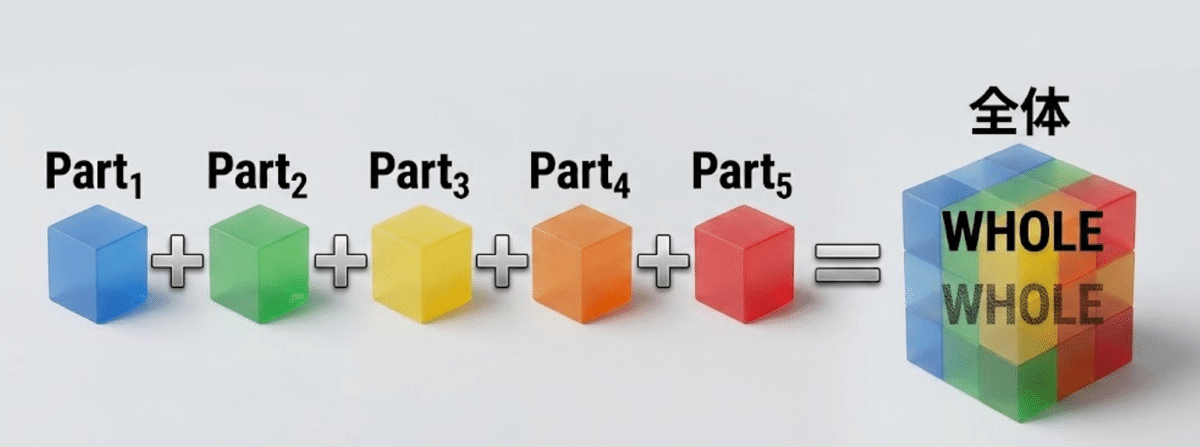
Underneath this philosophy lies a firm assumption: “the whole is nothing more than the sum of its parts.”
It may sound abstract at first, but in fact it is something very familiar to all of us.
Reductionist thinking in volleyball
Let’s zoom in and apply this to our own field, volleyball. In a reductionist paradigm, the game of volleyball is split into elements (components) like these (just one example):
- Decision-making (game intelligence)
- Technique
- Mental skills
- Physical qualities
- Tactics
The approach then assumes that by extracting a specific element, such as technique, and training it intensively, you can guarantee better performance from that player, and in turn from the whole team.
Let’s bring this down to concrete situations in the gym.
[Approach to an individual problem: improving spike efficiency]
Player A is struggling with a low kill rate. Say we identify one cause (element): an error, “the elbow drops during the swing.” To fix this precisely, we isolate the movement and prescribe repetitive training, sometimes standing swing practice or corrective drills with a towel, to improve the player’s finishing.
[Approach to a team problem: improving the side-out rate]
A team is struggling with a low side-out rate. As a solution, we extract one element: “reception quality.” Then, by devoting huge amounts of practice time to repetitive reception-only drills, we try to solve the team’s complex side-out problem.
Modularizing people
The most concise way to describe the reductionist process is probably modularization.
You treat a complex system (a player or a team) as a collection of independent parts (modules). You detach and extract the faulty module (for example, reception technique or physical qualities), upgrade it on its own, then plug it back into the system. Do that, and the whole system’s performance should improve. That is the thinking.
Reductionist training is nothing other than “modularizing” players and teams, and trying to optimize them by separating them into parts.
The benefits of reductionism, and what it does well
This approach of cutting things down to their smallest units seems to have driven explosive progress in modern science (especially physics and chemistry) from the 17th century onward. Its overwhelming power is proven by a history of breaking matter down to the level of molecules and atoms, and uncovering truths about the world.
In the world of machines and inanimate matter in particular, this method is extremely effective.
- Repairing a machine: when a car or a PC stops working, you take the system apart, identify the part (element) that is throwing the error, replace just that part, and the whole thing starts up again as if nothing had happened.
At this point, while writing this post, I noticed a paradox.
“Isn’t this post itself a reductionist approach?”
This series is called “Tactical Periodization Through Its Key Terms.” It picks out technical terms as “elements,” with the ultimate aim of understanding TP, a complex body of ideas. Yet in the early phase of taking in a huge amount of information efficiently, the reductionist approach really is excellent. It would be impossible to grasp the “big picture” of TP while skipping the assembly of parts called “understanding the terms.”
As an experiment, I took the Japanese word for reductionism itself, 要素還元主義 (yōso kangen shugi), and dissected it in a thoroughly reductionist way. The two diagrams below are in Japanese.
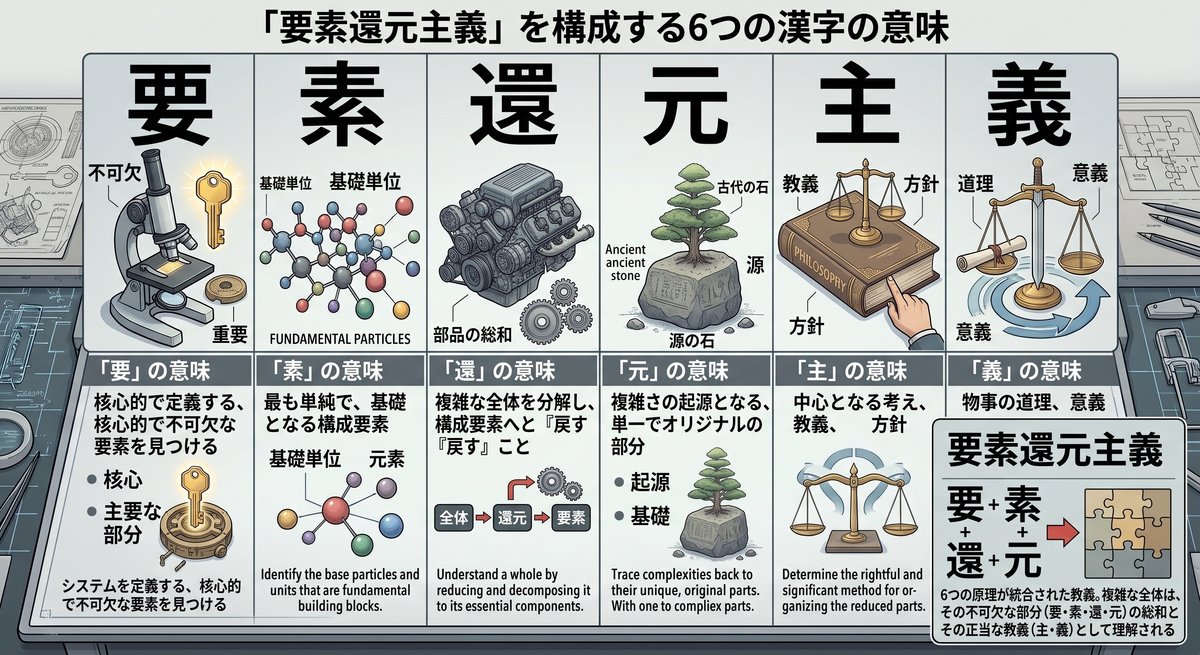
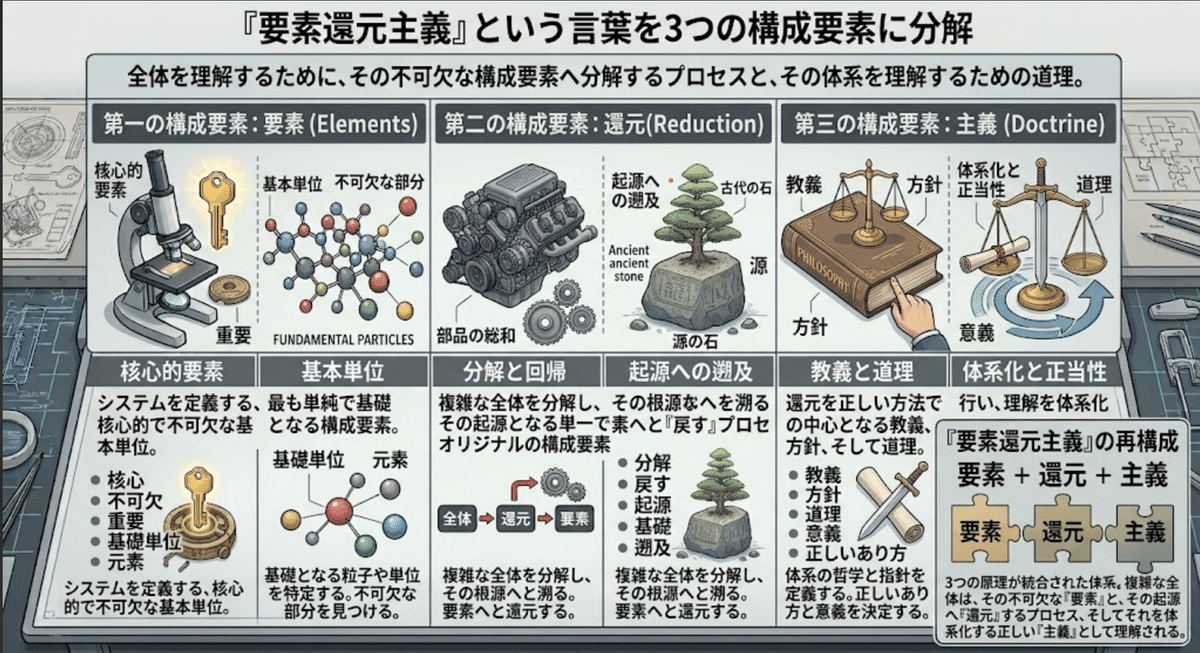
Whether you break the word down to its smallest units, six kanji characters, or divide it into modules, three compound words (“element,” “reduction,” “-ism”), you can unpack the structure of the word in depth.
In other words, when learning an unfamiliar concept and taking it in efficiently, this reductionist way of thinking is enormously valuable.
The limits of reductionism, and the reality of complex systems
On the other hand, reductionism has limits it cannot escape. When faced with a complex system, in which elements are organically intertwined and generate countless interactions, the method suddenly stops working.
So what is the true nature of the sport we face every day, volleyball?
Even if you focus on a single player, volleyball is a team sport. Teammates are positioned around you on the court, opponents stand across the net, and there is always a swirl of “interactions” that never stops, not even for an instant.
The conclusion is clear. Volleyball is a highly complex-system sport. It is not something you can control with simple reductionist logic.
In sport, closed drills that extract “technique” alone and repeat it in a noise-free environment have long been the tradition. They have some value in the early phase of learning a movement. But they do not include the elements that matter most in a real match: perception and decision-making. That is why, once players step into the complex environment of the court, they so often face the dilemma of being unable to use the technique they practised.