What Is Systems Thinking, the Foundation for Understanding TP?
日本語で読む →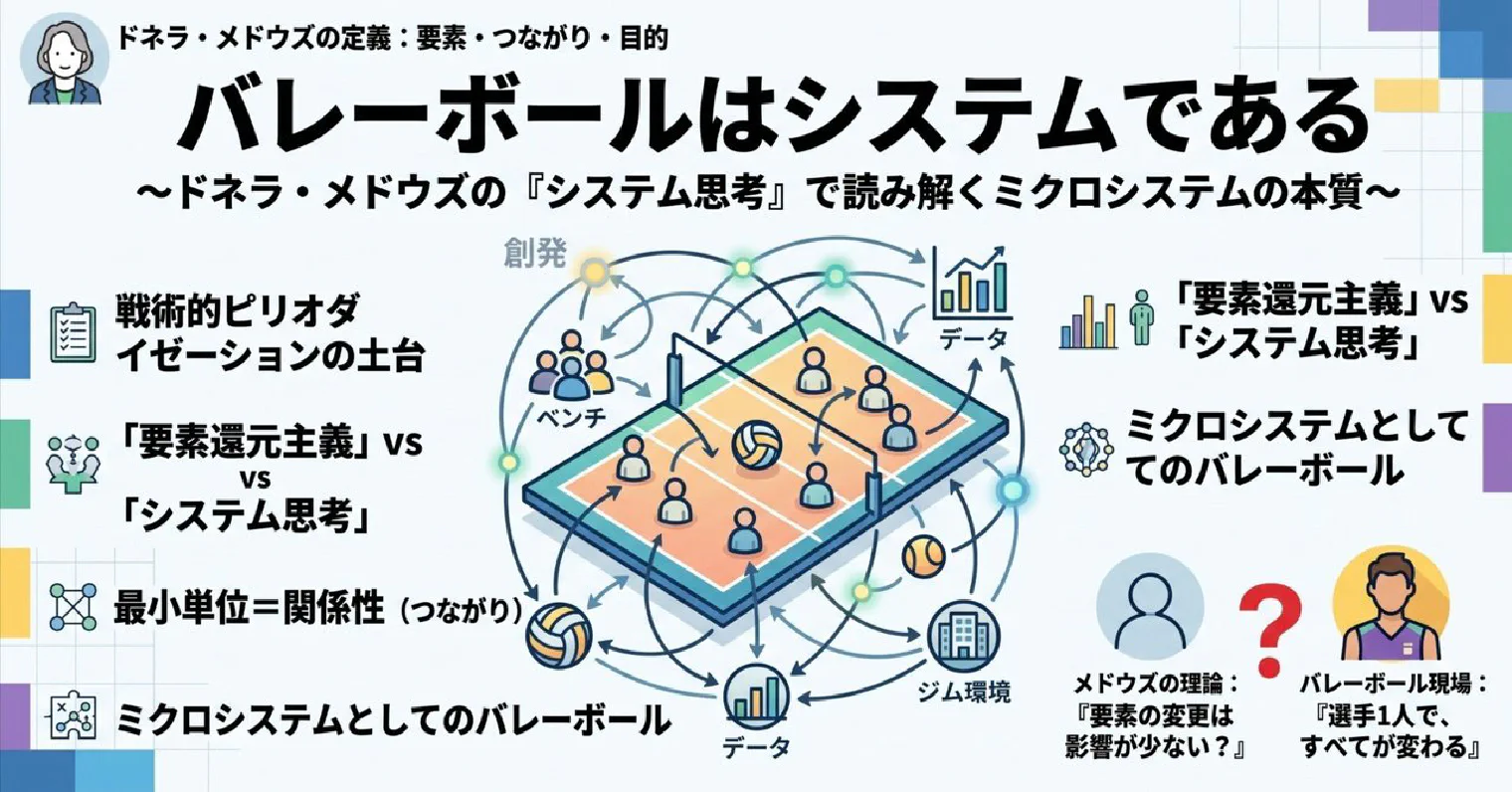
Tactical periodization (TP) rose as a new paradigm that challenged the reductionist approach. But to truly understand TP and use it in practice, it is essential to understand the concept it is built on: systems thinking. So this time, I dig into the question “What is systems thinking?”
What is a “system” in systems thinking?
Let’s start by understanding what a system means in systems thinking. It is not a system in the everyday sense, such as a machine, meaning “a tool or mechanism built for a specific purpose.”
In systems thinking, a system means
“a set of elements that influence one another and, as a whole, produce a single pattern of behaviour.”
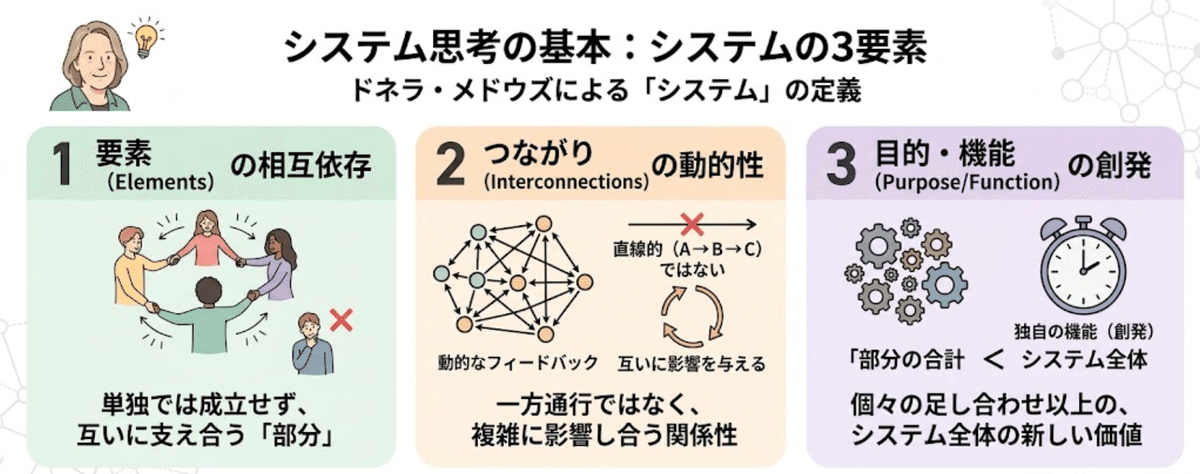
Donella Meadows, a leading figure in systems thinking, defines a system as a combination of three things:
① Interdependent elements: it is made up of multiple “elements” that depend on one another and cannot stand alone.
② Dynamic interconnections: the elements are not linked by straight-line cause and effect; they have “dynamic interactions (feedback)” through which they influence one another.
③ An emergent purpose or function: the system as a whole produces “its own function or purpose (emergence),” which cannot be reduced to the sum of its parts.
The difference lies in the “smallest unit”
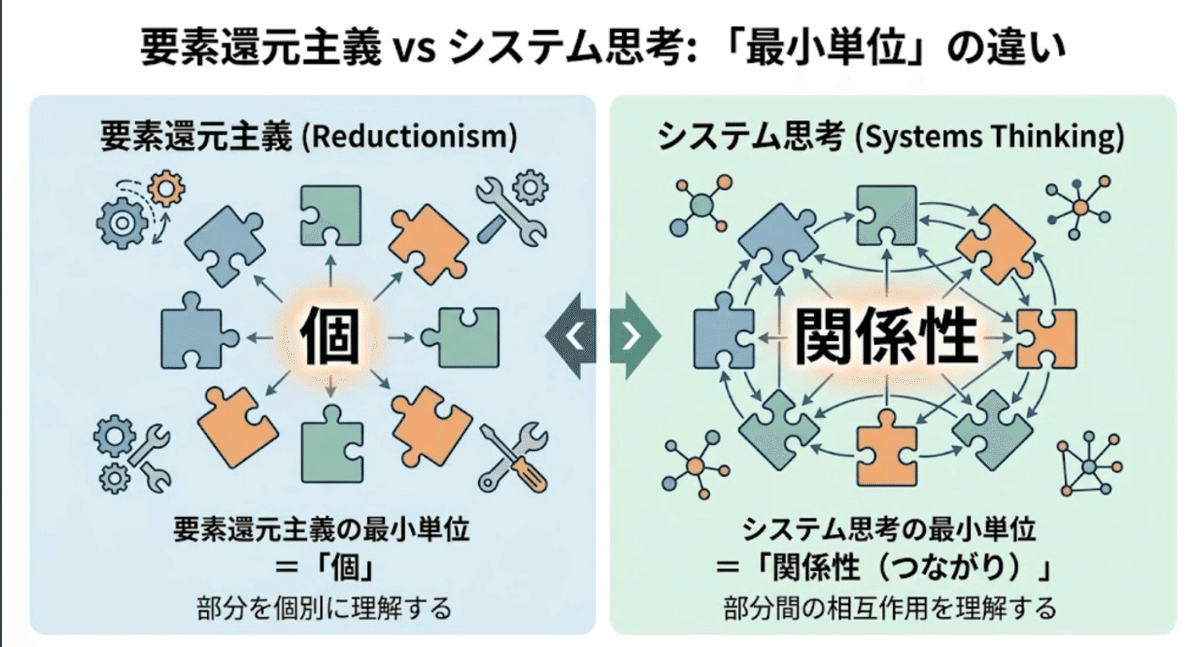
In other words, I think the biggest difference between traditional reductionism and systems thinking lies precisely in what each treats as the smallest unit.
- Reductionism’s smallest unit = the individual
- Systems thinking’s smallest unit = the relationship (the connection)
Put simply, systems thinking does not chop things up and look at them as “points.” From the start, it tries to see them as “lines” and “loops” (cycles).
Volleyball is a system
We said that a system is made of interdependent elements, dynamic connections, and a purpose for the whole. Let’s step back and apply this to volleyball.
- Elements (who and what is involved): everything involved, not only the players on the court but also the bench staff, the data (stats), the gym environment, even the ball.
- Interactions (how they influence one another): because you cannot hold the ball in volleyball, each play directly affects the next. The server’s target pushes the receiver off balance, which limits the setter’s options, which changes the hitter’s contact point and the movement of the opposing blockers. Player ↔ player, front row ↔ back row, player ↔ data: countless connections follow one after another, so many that they cannot be cleanly separated.
- Purpose or function (what it aims for): growth as a team, carrying out the tactics and the game model, and winning.
Changing the elements has little effect? A thinking trap we fall into
One very interesting point in systems thinking is that, according to Meadows, of the three components of a system (elements, interconnections, purpose), the elements are the easiest to see, yet changing them has the least effect on the system as a whole.
But the more you work in volleyball, the more strongly this statement will strike you as contradictory or simply wrong. We know from real matches that replacing just one player can change a team’s performance drastically, and sometimes even has a huge effect on the team’s game model itself.
“If changing the elements is supposed to have little effect, why does one substitution transform the team?”
In fact, I had a big misunderstanding here myself. Meadows’ words sounded like an armchair theory to me because I was unconsciously looking at the system through a reductionist filter.
I had instinctively taken the element, the system’s smallest unit, to be “one player (an isolated individual).” But the smallest unit of analysis defined by systems thinking is not a lone “individual.” It is the interactions (connections) woven together by multiple elements.
In other words, in volleyball, replacing one player is not simply “swapping a part” in a machine. It is an act that forcibly rewrites the entire network of the smallest units, the “interactions (connections),” that the six players on the court had been creating.
From a reductionist point of view, a substitution looks like “only one-sixth has changed.” From a systems-thinking point of view, “countless interactions (connections) have all been replaced.”
If the “interactions,” the smallest units of the system, change, then of course the behaviour of the whole (the team’s performance) is badly shaken too. This is why the more a team depends on a particular player, the more dramatic its collapse when that player is missing.
If you build a game model that depends on particular people, assuming the abilities of specific “individuals,” then the moment that element (player) is missing, you have to rewrite the blueprint of the entire system.