OPTIMAL Theory: Accelerating Motor Learning
日本語で読む →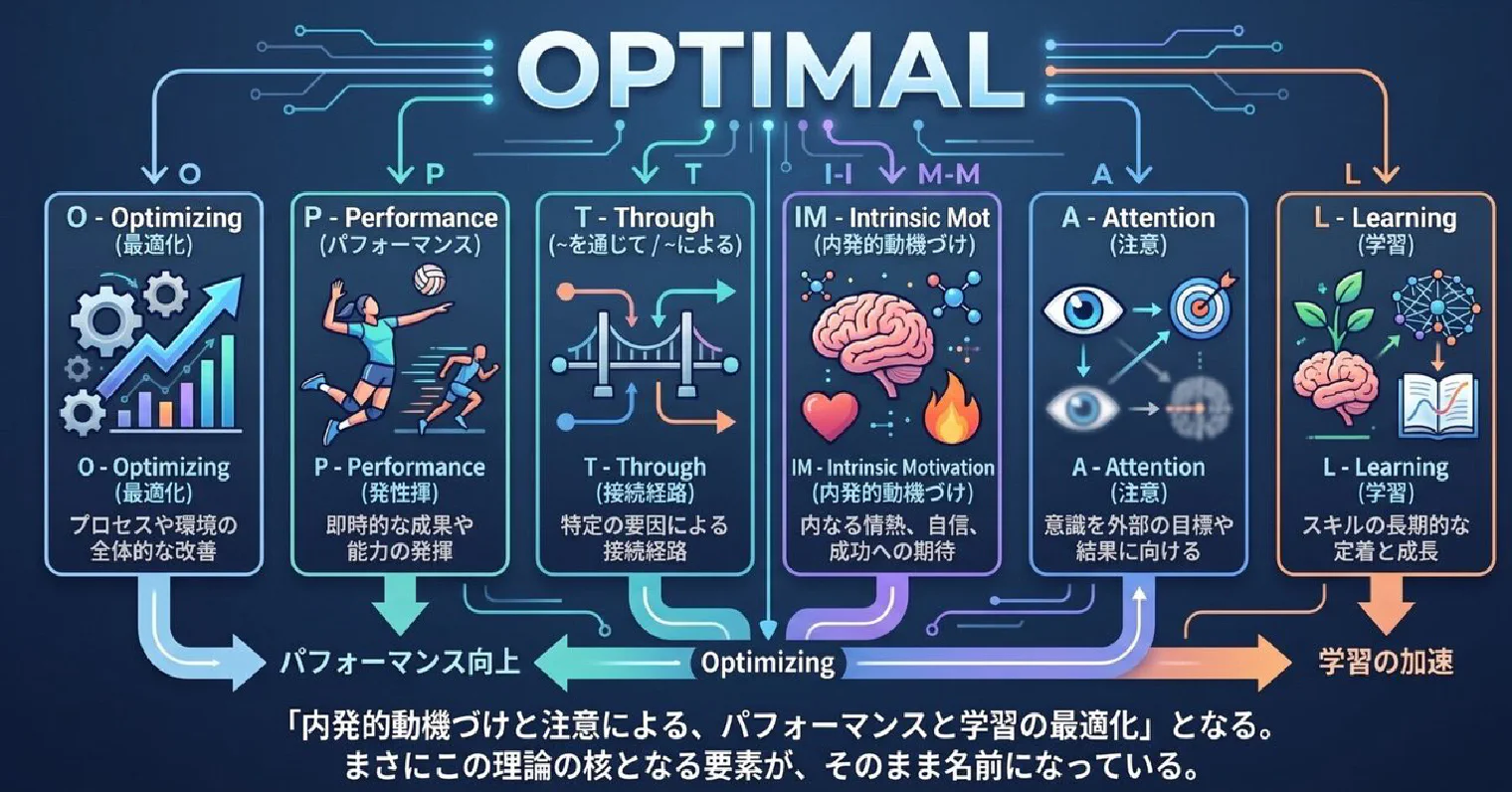
The rise and fall of the information-processing approach
For decades, theoretical frameworks for motor learning have been built on information-processing models. The best-known examples are the three-stage model proposed by Fitts and Posner (1967), made up of the cognitive, associative, and autonomous stages, and Schmidt’s schema theory (1975).
The three stages of motor learning
① Cognitive stage
The early stage, in which the learner tries to understand “what to do” in their head.② Associative stage
The middle stage, in which the learner refines “how to move” and corrects the movement.③ Autonomous stage
The final stage, in which the movement can be performed unconsciously and “automatically.”
Schema theory
The theory that “the brain does not memorize every movement. It remembers only two things: a basic template and the rules for fine-tuning it.”
The basic template (GMP, generalized motor program): the fundamental form of a spike, “jump and swing the arm.” This is the common “base” shared by every spike.
The rules for fine-tuning (the schema): principles for adjusting force and timing to the situation, such as “the set came off the net, so wait a little longer” or “the block is closing in, so swing earlier.”
“The more you practise in varied environments and conditions (variable practice), the more refined the schema (the rules) becomes, and the better you can cope with situations you have never seen before.”
These two great theories of the information-processing model (the three-stage model and schema theory) are certainly persuasive. Yet with recent advances in sport science, their underlying assumptions are starting to crumble.
Especially in “complex-system” sports like volleyball, where the situation changes from moment to moment, researchers have pointed out one contradiction after another that the traditional models cannot explain. There are three main reasons.
1. The limits of processing speed
Volleyball is played in fractions of a second. In that instant, a serial process of “perceive the situation, compute using schemas and patterns in the brain, then send output to the muscles” simply cannot keep up, physically.
2. Coping with non-linear change
Both the human body and the game of volleyball itself are “complex systems.” Fine-tuning a single pre-prepared template, or changing how much force (the parameters) to use, is not enough to cope with an environment that never stops changing.
3. Separation from the environment
Earlier approaches claimed that “skills are accumulated and stored in the brain.” In the complex-systems paradigm, however, skill does not live inside the brain. It exists “between the person and the environment.”
In other words, information-processing approaches that treat the brain like a computer (the three-stage model and schema theory) are not enough on their own. They do not develop the ability to adapt instantly to the chaos of a match and solve problems creatively.
The next paradigm: OPTIMAL theory, a framework for optimizing learning
Now that the limits of the information-processing approach have come into view, sport science is entering a new phase. One framework drawing attention for dramatically accelerating motor learning is OPTIMAL theory, proposed by Wulf and Lewthwaite (2016).
What is OPTIMAL theory?
“OPTIMAL” is an acronym. Each letter stands for:
O - Optimizing
P - Performance
T - Through
IM - Intrinsic Motivation
A - Attention
L - Learning
Put together: “Optimizing Performance Through Intrinsic Motivation and Attention for Learning.” The core elements of the theory are the name itself.
The idea that “by shaping a player’s motivation and where they direct their focus (attention), the body automatically learns the optimal movement, and improvement accelerates.”
Instead of coaching that intervenes directly in body mechanics (biomechanics), such as “swing your arm like this, rotate your hips,” the theory focuses on designing the learner’s psychological and cognitive state.
From an era of “programming the correct movement into the brain” to an era of “designing the environment and the state of mind in which optimal learning happens.” This is the great paradigm shift from information-processing models to OPTIMAL theory.