A System, Yes, but a Complex One
日本語で読む →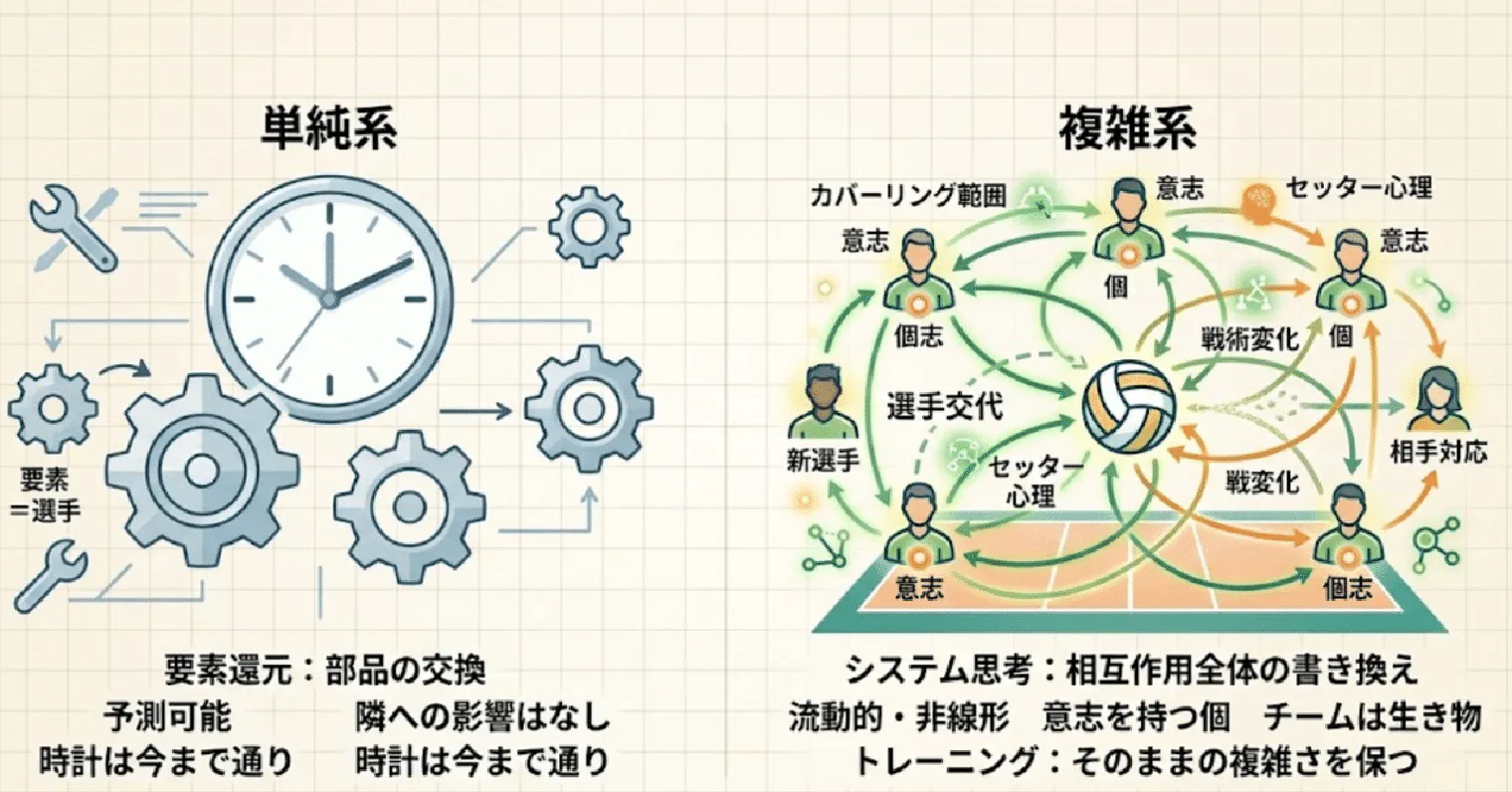
Simple systems and complex systems: a thinking trap we fall into
The more you work in volleyball, the more Meadows’ statement that “changing the elements has little effect” will feel wrong. I felt the same way at first. But here lies a big thinking trap that we easily fall into.
We unconsciously treat the system as a simple system, like a clock or a machine, and see the element, the system’s smallest unit, as “one player (an isolated individual).”
Simple systems
Systems in which the interactions are relatively simple.
Think of machines such as clocks and cars. In these, the behaviour of each component and the interactions between components are relatively simple. They are predictable systems.
In a simple system, if you replace a broken gear (an element) with a new gear of the same specification, the way it meshes with the neighbouring gears (the interaction) does not change. The clock keeps ticking just as before. If you start from this assumption, it is natural to think: “Even if we replace a player (a part), the team should function the same way as long as the tactics don’t change.”
But ecosystems, human societies, and the game of volleyball are complex systems, fundamentally different from mechanical systems like these.
Complex systems
Systems with a large number of components, in which the interactions are fluid, unpredictable, and highly complex.
Ecosystems, human societies, and volleyball teams are complex systems, fundamentally different from mechanical ones. The defining feature of a complex system is that each component (player) has a will of its own, and the connections between components (interactions) are always fluid and unpredictable (non-linear).
In short, volleyball can be called a complex system.
Volleyball is a complex system in which the interactions get rewritten wholesale
In systems thinking about complex systems, the smallest unit of analysis is not the isolated “individual” but the “interactions (connections)” woven together by multiple components.
This is the most important point. In volleyball, replacing one player is more than just “swapping a part” in a machine. When a new player comes in, the relationship with the players next to them changes, the coverage areas change, the setter’s state of mind changes, and the tactics the team chooses will likely change too. In turn, even the opposing blockers’ tactics change in a chain reaction.
In other words, a substitution that looks like “only one-sixth has changed” from a reductionist point of view means, from a systems-thinking point of view, that “the entire network of the smallest units, the ‘interactions’ the six players on the court had been creating, has been forcibly rewritten.”
If the “interactions,” the smallest units of the system, change, then of course the behaviour of the whole (the team’s performance) is badly shaken too. If a game model depends too heavily on particular players, then the moment one of them is missing, the team will be forced into “a major change to the whole system,” such as a fundamental rethink of its tactics and rules.
In volleyball, “when the players change, the system changes” is a phenomenon unique to complex systems: a change in the elements triggers a complete reset of the connections (interactions).
Treating volleyball as a complex system
We face problems like these in everyday practice: “they can do it in practice but not in matches,” or “when one particular player falters, the whole team stops working.” Perhaps the root cause is not a lack of ability in the players. Perhaps it is that we try to train volleyball, a complex system, by cutting it into pieces in a reductionist way, as if it were a simple machine.
For players to make their own decisions and perform as a whole amid the chaos of a real match, we need a way of thinking that does not break the elements apart. Instead, we train the whole system, including these “countless intertwined interactions,” while keeping its complexity intact.
The true nature of volleyball as a complex system is not a collection of “points” such as clean technique or stats. It lies in the chaos of ever-changing, unpredictable “lines” and “loops” tangled together.
How do we train a team, a complex living thing, without dissecting it? Perhaps that is our role as coaches.