Unpacking Traditional Coaching and Its Historical Background
日本語で読む →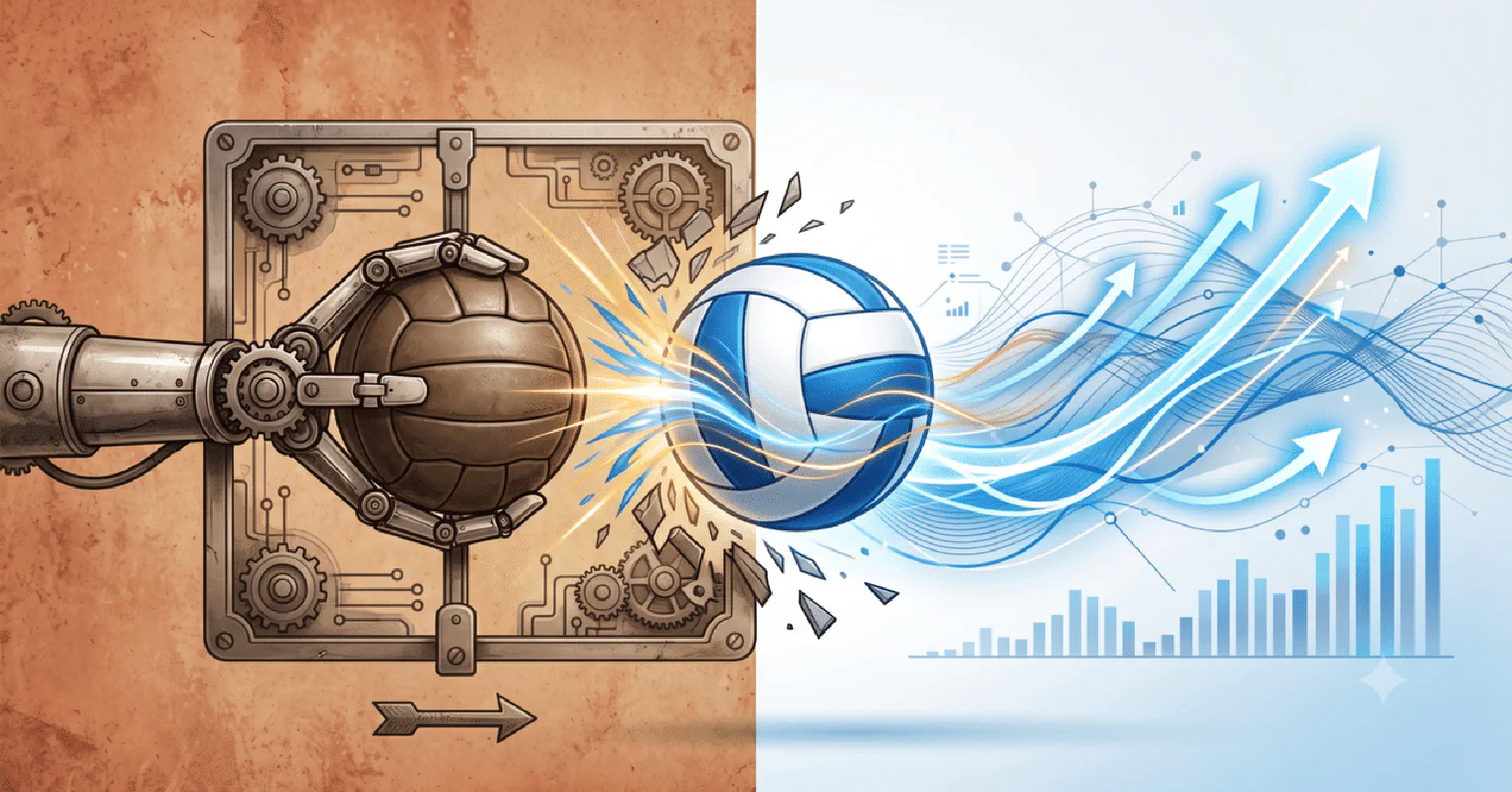
Introduction
For a long time, people believed that if you defined the technique that is optimal for everyone, and players learned to reproduce it reliably, they would become good players. Research was done along those lines, and that style of coaching became the mainstream.
From here on, I will call this the traditional approach.
The traditional approach treats people like machines. Skills are stored in the brain, and from that stored data bank, the player instantly selects the play most likely to be the best answer. Acquiring a new skill is like installing new software on a PC. In other words, the human being (the player) is being treated as a kind of machine.
But what do you think? Are we really that simple? Is the process by which human beings learn skills really that simple?
Physical characteristics, skeletal structure, intelligence, even personality and each player’s own background: everyone is different. Even if there were a manual that defined the perfect technique and explained how to install it, could it really apply to everyone?
If we think it through logically, we know “that can’t be right.” So why have we believed in this traditional approach? One reason, I think, is that we ourselves were coached that way when we were players.
In this post, I want to think about the background: how we arrived at this approach, and why it remained the mainstream for so many years.
Ease for the coach
The ideal was to turn the single most efficient “right answer” (the one best way) into a manual, have players repeat it in practice, and make them move as precisely as machines.
I believe this approach, “define the right answer and have players reproduce it faithfully,” has a lot to do with how easy it is for the coach.
For the person coaching, teaching everyone “the same right answer” is very efficient and easy to manage. You only need to say, “This technique is correct, so do it exactly like this.” And the standard of evaluation becomes a simple either-or: “Are they doing it as taught (by the manual), or not?”
In other words, you can skip entirely the huge, complex process of engaging with each player’s individual characteristics, and make coaching much simpler. But human learning does not work that way. Furthermore, since volleyball is a highly complex sport, mechanically reproducing fixed movements is not enough. Or rather, it is fundamentally the wrong idea.
The rise of the information-processing model
On top of “ease for the coach,” perhaps something like the “scientific trend” of the time also influenced this approach.
The idea of “drawing the best answer out of the brain’s data bank” seems to me closely linked to the information-processing model in cognitive psychology of the 1960s and 70s. As computers began to spread through society at that time, a way of explaining the learning process emerged that likened “the human brain to a computer.” My guess is that this was then carried over into motor learning in the world of sport.
“Input (visual information) → processing in the brain (selecting a program) → output (movement)”
Perhaps there was a historical background in which this theory, which treats people exactly like sophisticated PCs, spread as the cutting-edge sport science of its day.
The culture of kata in martial arts, and school physical education
There is also a background specific to Japan. The culture of valuing kata (set forms) in the martial arts may also have had an unconscious influence.
This is the idea of shu in shu-ha-ri (the Japanese model of mastery: first protect the form, then break it, then leave it): you start by copying your master’s form thoroughly until it is ingrained in your body. And within the history of group education in Japan, there seems to have been a feeling that “everyone performing controlled movements with high consistency” was a good thing. That atmosphere, too, may have influenced coaching.
Of course, the martial arts have their own deep logic and purposes, and I think it is a truly wonderful culture in itself. I am not an expert in martial arts, so I should not say anything careless. But at least when compared with the nature of volleyball, the situation is clearly different.
Volleyball is a “complex-system” sport in which the situation never stops changing. Players are constantly affected by external factors: the movements of opponents and teammates, thinking about the next play, and so on. I feel that the split-second decisions demanded in that environment are, to a large extent, beyond what an approach of “reproducing a predetermined form” alone can cover.
Despite this difference in nature, perhaps the approach so familiar to us, “teaching by fitting players into a form,” was naturally carried straight over into volleyball coaching and became established there.
The memory of a great success
Japanese volleyball has a great success story that thrilled the world. The best-known example is the gold medal won by the “Witches of the Orient” (Japan’s women’s team) at the 1964 Tokyo Olympics.
The way they polished their “ideal movements” to perfection through tremendous effort and repetition at the time is, I think, something every volleyball coach should understand deeply as part of their education.
However, precisely because that success was so great and so powerful, it may also have been handed down in coaching, long and deeply, as “the absolute right answer” in Japanese volleyball.
Closing
Ease of management for coaches, the scientific paradigm of the time, traditional Japanese culture, and a great success story. These have intertwined in complex ways, and the traditional approach has taken deep root in our coaching.
But times have changed, and sport science keeps updating. Understanding this background, how should we engage with players’ learning from now on? Isn’t now exactly the time to rethink our approach?